
ICE Protocols & Policies for Episcopal Churches
INTRODUCTION
On January 21, 2025, the Department of Homeland Security (DHS) revoked a longstanding “protected areas” policy that prohibited immigration enforcement officers from entering places of worship for the purpose of conducting immigration arrests. At this time, places of worship - as well as other “sensitive locations” such as schools - are no longer off-limits to Immigration and Customs Enforcement (ICE) and Customs and Border Patrol (CBP) officers.
ICE can now seek to detain or question immigrants inside places of worship, but there is a lot we can do to fulfill our spiritual calling to create safe spaces where we welcome and serve all people, and worship without regard to immigration status. Despite the reversal of the protected areas policy, there are basic constitutional rights that still apply, and churches and their members can enact policies to ensure that these rights are protected.
On Tuesday February 11, 2025, two dozen Christian and Jewish institutions, including the national Episcopal Church and the Massachusetts Council of Churches (ECM is a member of both), filed a lawsuit in federal court against the Department of Homeland Security, arguing that their policy violates our First Amendment right to freely worship. Rescinding the sensitive locations policy has had a chilling effect on our ability to fully engage in religious assembly, pastoral care, and our practice of providing social service ministries.
Bishop Julia Whitworth of the Episcopal Diocese of Massachusetts (EDOM) and Bishop Douglas Fisher of the Diocese of Western Massachusetts have both signed onto this statement by the MA Council of Churches, opposing the DHS policy change on sensitive locations.
This guide has been designed for Episcopal Churches in Massachusetts that are interested inplementing protocols and policies to provide safe places to worship and to protect ministry services despite the potential threat that ICE might seek access to church buildings, individuals, or data. Most of the content will be relevant to any kind of house of worship in MA, although we will be using the terms “church” and “parish” for our Episcopal audience.
If you are outside of MA, there may be state-specific laws or policies that are different from what you read here - please make sure to be fully informed about your local context.
If you are interested in a video on this topic, you can access this recent webinar, “Know Your Rights Training for MA Faith Leaders” with the MA Attorney General's Office and Partners.
FREQUENTLY ASKED QUESTIONS
-
A: You need a lot less information than you think you do! You do not need to understand the ins-and-outs of the U.S. immigration system, asylum, or deportation. You definitely do not need to know (and should not ask) anyone’s specific immigration status at your church. All you really need is a clear understanding of the church’s rights, and the rights of people inside the church. These same rights can and should be asserted whether someone is at risk or not.
-
A: Although there is no one process that works for every congregation, there are some steps that should apply in most cases.
First of all, bring your request to the decision-making body of your congregation. In Episcopal Churches this will likely be the vestry, as well as the Rector/Priest. Be prepared to answer questions, and to provide educational resources and be empathetic if some members are skeptical or worried about legality. For Episcopal Churches, you can turn to both Episcopal Migration Ministries and the Episcopal Diocese of MA to emphasize that these actions are supported by the larger Church, nationally and locally.
Once a decision is made to move forward with a protocol and signage, adapt the samples here or others you find elsewhere to your specific congregation and complete your church’s regular process for new policies and procedures. Not every church will want as thorough a policy as the samples here. You may have reasons to adopt one but not all of the policies. We recommend that signage for doors be sturdier than regular paper - at least laminated, or even professionally printed to match other church signage.
Make sure that all employees and volunteers that may be staffing the entrances are trained and comfortable with the protocol, and have a chance to ask questions. You may want to incorporate live role-playing. If you don’t have answers to their questions, you can bring them to us at Episcopal City Mission by emailing admin@ecmteam.us.
In congregational newsletters and services, include a brief announcement about the new protocol and signage and why they are being put in place.
Check in periodically with your team, and make sure that any new staff or volunteers that join are informed as part of their on-boarding process.
While being prepared in case of ICE presence is important, the likelihood of this occurring remains low. Make sure to keep the tone calm and treat this as any other form of emergency preparedness (such as a fire) - highly unlikely but important in the off chance it ever does occur. -
A: Episcopal City Mission highly encourages every Parish to take steps to be well-informed and prepared so that churches can continue to meet their religious call to welcome the stranger and to meet the needs of the vulnerable. As houses of worship, we have a wide range of people who participate in our activities and come through our buildings. Our signs communicate clearly what we believe and value. Signage about ICE should not just be associated with places where there are people at risk, or that could be an invitation for certain communities to be targeted.
Additionally, when a critical mass of Episcopal Churches know their rights when it comes to serving the immigrant community, it is more protective for all Episcopal Churches and especially for those who have members who may be targeted or feel vulnerable to immigration enforcement. As directed by our faith, we want all of our churches to be places of welcome. Enacting policies that help to deter interference with our call allows us to better be able to put our faith in action. If we have a reputation as a denomination that is informed and prepared, we create a larger deterrent for ICE to try raiding any Episcopal Church. Think of this as a form of emergency preparedness, similar to fire safety plans. It’s unlikely to happen, but you definitely want to be ready if it does. -
A: You are only legally required to allow ICE officers into private spaces (see public/private space section below) within your building or grounds if, and only if, they have a judicial warrant signed by a judge or magistrate. This is different from an “ICE warrant” which agents may present as a “warrant” but it does not hold the same weight. See the examples provided and Click here for a step-by-step guide on validating a judicial warrant.
All staff and volunteers monitoring entry to the building can be trained to know the difference between the two documents, or you can have a central point of contact on-site who is contacted to review any “warrant” before admitting entry. Make sure that your central point of contact is a U.S. Citizen, and it’s helpful to also have an immigration attorney lined up who can be called.
Church staff members and individuals are not required to answer if ICE agents enter the congregation and ask questions. The right to remain silent always applies, and no one is obligated to answer questions from ICE. For suggested responses for your staff and volunteers, see the sample “Privacy and Information Sharing” protocols below. It is always acceptable to refuse to answer questions and clearly state, instead, “I am exercising my right to remain silent.”


LEGAL RISK LEVELS & ACTIONS
-
(Note that this is not “no risk” because we cannot be certain how ICE might respond even when all laws are being followed.)
Posting a sign on your church’s entrances restricting access to private spaces unless ICE presents a judicial warrant.Stopping ICE in the entryway and asking to see a judicial warrant, and telling them to leave if they do not have one.
Refusing to answer any questions from ICE agents.
Marking certain spaces and/or files in your building as “private” to limit ICE from accessing them.
Simply having people that are undocumented immigrants present in your church, home, car, etc.
Providing services to undocumented immigrants such as shelter, a food pantry, etc.
Providing “know your rights” information about ICE to people broadly, including people who are undocumented.
Broadly letting people know when ICE is present in a location.
-
You increase risk when you ask people who you think may be undocumented for their immigration status. Do not ask for, and especially do not document, unnecessary data. If someone tells you they are undocumented, do not put it in writing anywhere including over email or text.
Approaching a specific person who is at risk from ICE and encouraging them to leave or hide because ICE is present at the entrance.
-
Lying to ICE or another law enforcement agent in order to keep them from finding someone. (For example, saying they are not in the building when they are - although it is safe to refuse to answer.)
Secretly guiding someone who is at risk of immigration detention out of the building when ICE is at a different entrance.
Destroying written data that you have already collected in order to prevent ICE from accessing it.
-
Preventing ICE from entering even though they have a judicial warrant.
Physically intervening with ICE to stop them from detaining someone, even if gently touching an officer as a deterrent. This is not only risky for the person intervening, but can also complicate or worsen things for the person being detained.
-
A: While ICE and other law enforcement agents need a judicial warrant to enter private spaces, they do not need warrants to enter public spaces. In the case of churches that welcome the public into the sanctuary for worship, the sanctuary may be considered a public space during worship times, but it is allowed to limit that public use to only appropriate and related activities. Greeters at the door to a public space can still inquire into the purpose of the visit and refuse entry into, for example, Sunday services which are otherwise considered public. See below for sample protocol on defining public vs. private spaces in your church building. Please note that these distinctions may not be respected by ICE officers, and we recommend carefully documenting any encounters that may occur.
-
A: These protocols are designed to support and protect our religious right to association and were designed to be in conformance with the law. They have been carefully legally reviewed.
Providing shelter, food, or other services to a broad set of people, regardless of immigration status, is not harbouring. Publicly adopting a policy of nondiscrimination, regardless of immigration or citizenship, is not harbouring. Providing services broadly does not become “harboring” when undocumented immigrants use them. A homeless shelter that does not ask details about immigration status cannot be charged with “harboring” simply because undocumented immigrants stay there.
It is true that there are legal risks in certain circumstances, such as actively intervening to stop ICE from detaining someone or transporting undocumented immigrants in an attempt to hide them from federal authorities. The existing federal “harboring” laws (section 1324(a) of the Immigration and Nationality Act of 1952) have never been successfully applied against any church or non-profit. That said, we are in unprecedented times and it is important to know what actions are higher risk and what those risks could entail. If you have specific concerns or questions, it is important to seek additional guidance from legal counsel.
If you have specific questions or concerns, please consult legal counsel.
If you are looking for further details, the National Lawyers Guild and partners have recently created a guide for assessing risk in the context of supporting immigrants.
For a recent webinar to Know Your Rights as a congregational leader, you can watch this video from the Massachusetts Attorney General’s office, hosted by Jewish Community Relations Council and the Massachusetts Council of Churches.
Be aware that the risks go beyond legal ones - outside harassment is a possibility if it is publicized that your congregation is taking these steps. Visibility has value, but also risks. Make careful decisions about whether you are willing to be identified in local media, for example. If you experience hate messages or calls, track the information and provide pastoral care to anyone targeted by these messages. Ultimately, carrying out the values of our faith in this way is effective and meaningful, which is why it can attract strong opposition. This is unlikely in most cases but something to be prepared for as well.
-
A: In addition to adopting these protocols and training the staff and volunteers, programs like food pantries can put up “know your rights” posters in multiple languages and print and distribute “know your rights” red cards. If the existing relationships are strong enough, consider working with the ACLU to offer a family preparedness clinic with trained volunteers and a notary public to confirm signatures for documents - but keep the promotion to known networks and do not advertise publicly.
-
UUMassAction has created a fantastic “Congregational Immigrant Justice Action Guide” which we recommend using! It is more extensive than what we can provide here.
Partnership: If your congregation is “in solidarity” but not directly impacted, there are likely other houses of worship near you serving largely immigrant communities. If you haven’t already, reach out to build relationships, express your support in these times, and see if there is any form of relationship or partnership they would be interested in building. Ask if they could use support in getting and distributing Know Your Rights information - they may likely already be doing it, but it can be helpful to have a partner focus on those materials so that they can focus on the immediate needs of their congregants. Identify other institutional relationships that members of your congregation already hold, like if they teach at a school or work at library, and how those channels could also be used for “know your rights” education.
Volunteering: In Eastern MA, the Boston Immigrant Justice Accompaniment Network (BIJAN) provides many opportunities to support immigrant neighbors resisting detention and deportation, including court accompaniment, answering their hotline, and providing rides to appointments. Please see their current list of volunteer needs here. You can sign up on their form as well as donate or raise money for their Beyond Bond and Legal Defense Fund. There is also a network of congregations and individuals hosting immigrant families who have lost access to the MA shelter system due to recent policy changes. Connect with opportunities to provide housing and meet other needs on the Current Opportunities to Support Asylum Seekers guide by the Interfaith New Neighbor Coalition.For outside the greater Boston area, look for your local immigrant-led grassroots organizing and your local MCAN (MA Community Action Network) affiliate (check out their map to find yours) which will likely have an immigrant rights campaign.
Advocacy & Organizing: Sign up for the email lists and follow the social media of organizations doing local immigrant justice advocacy for up-to-date opportunities for actions. In MA this includes the MA Immigrant and Refugee Advocacy Coalition (MIRA), Stories Inspiring Movements (SIM), Neighbor to Neighbor, Episcopal City Mission, and UU Mass Action. There are many emerging opportunities for public action and you can organize your congregation to attend as a group. You can also host events or a table during coffee hour to invite others to take action (calls and letters) together for state legislation such as the Dignity Not Deportations Act.
Within the Episcopal Church nationally, you can get involved with Episcopal Migration Ministries (if you aren’t Episcopal, your denomination or faith tradition may have a similar refugee resettlement or migrant justice organization to connect with on the federal level) and the Episcopal Public Policy Network. (Similarly, your denomination or faith community may have a federal policy office.)
CLICK ON THE PROTOCOLS BELOW FOR STEP-BY-STEP INSTRUCTIONS
CLICK ON THE PROTOCOLS BELOW FOR STEP-BY-STEP INSTRUCTIONS
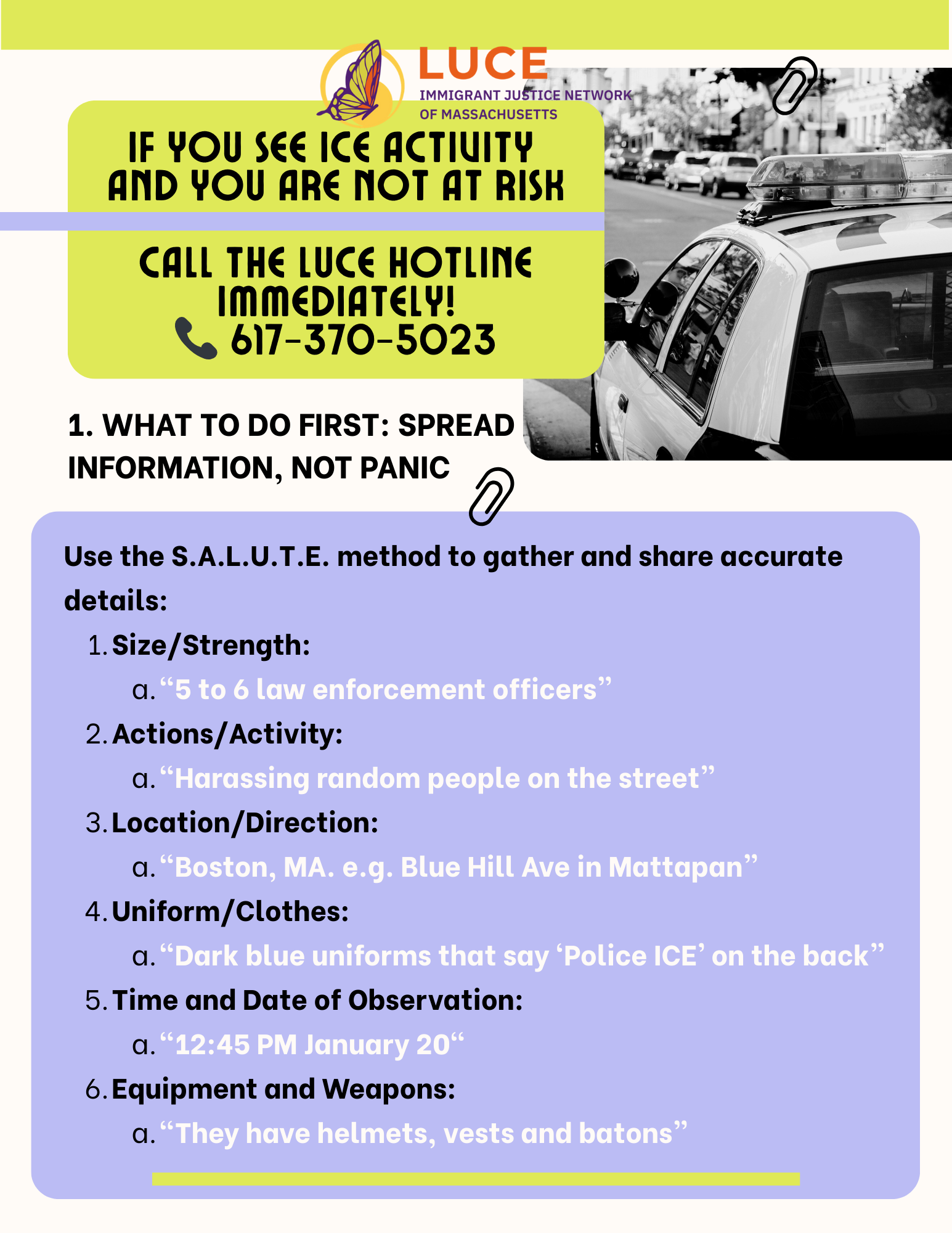
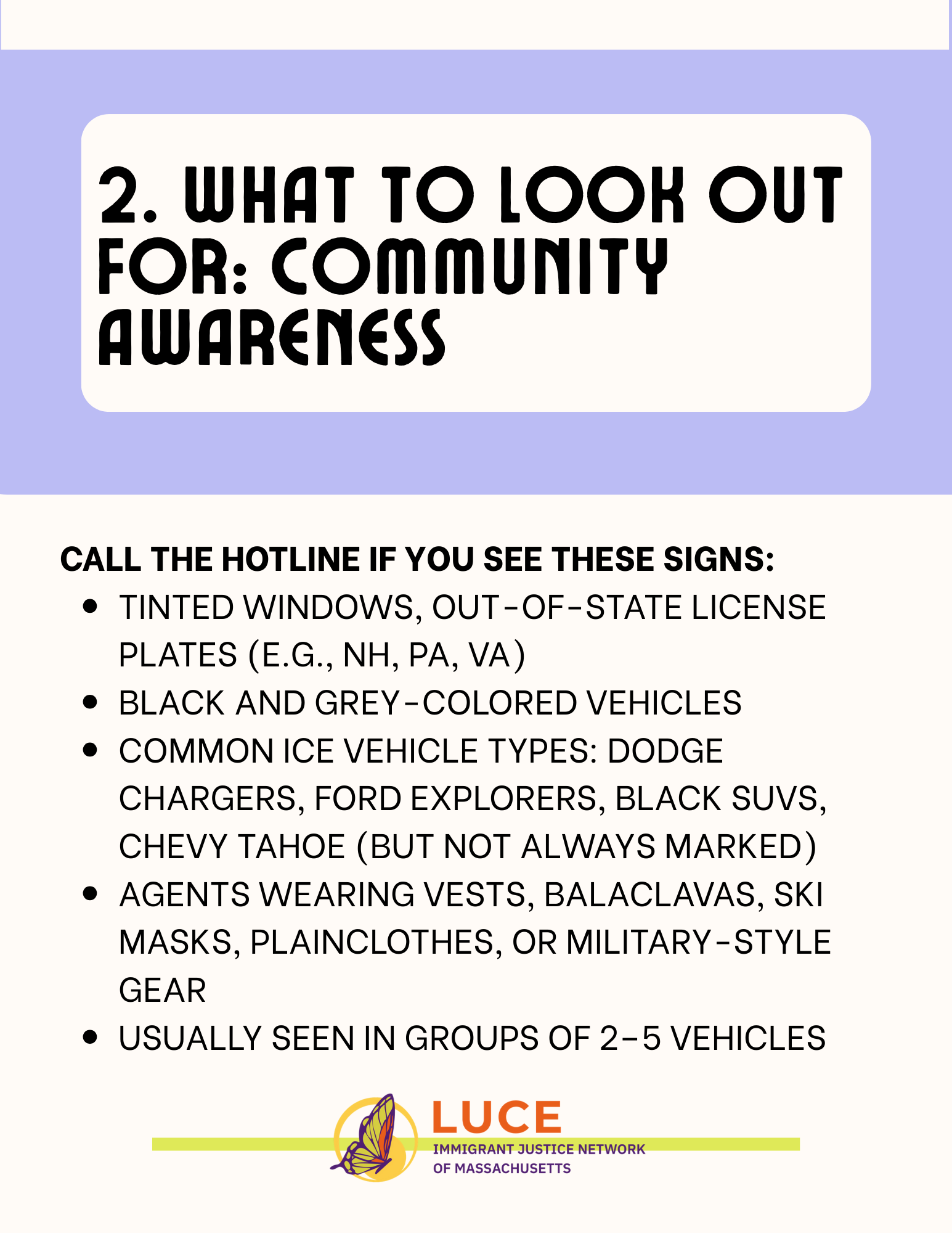
IF YOU SEE ICE ACTIVITY - USE THE STEPS BELOW
IF YOU SEE ICE ACTIVITY - USE THE STEPS BELOW
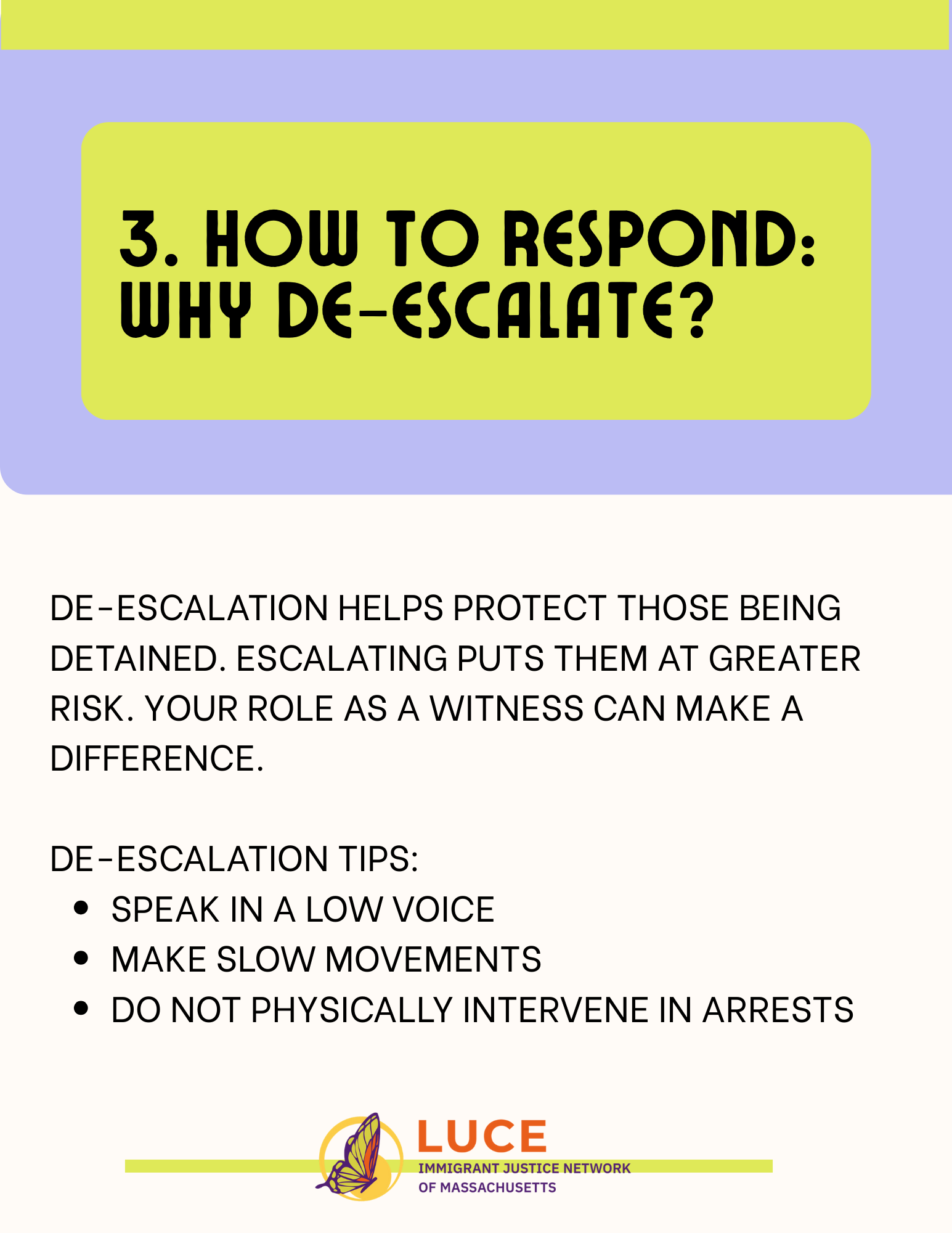

Information/Source from: LUCE and S.A.L.U.T.E from South Bronx Mutual Aid
Bibliography
This development of this guide relied heavily on the following sources:
“ICE Raid Guidance for Homeless Service Providers: What to do Before, During, and After A Raid” by the National Homeless Law Center
If you would like to work directly with Episcopal City Mission on your congregation’s immigrant justice organizing, or if you have questions or comments, please email admin@ecmteam.us.
TO DOWNLOAD THIS PAGE AS A PDF OR PRINTABLE COPY SEE BELOW